 Daniel Thornton
Key Takeaways
- F5 on a La Cornue Château gas range means the oven gas safety valve has failed, and it must be replaced by a certified technician.
- If the igniter glows bright orange but gas never flows, and there is no gas smell, the valve rather than the igniter is the suspect.
- A valve that works only intermittently is unpredictable; stop using the oven and schedule the repair.
- The third possible cause is a control board that is not sending the signal, so the diagnostic verifies coil resistance, igniter amperage and board output first.
- After a valve replacement, a gas leak test and a combustion analysis are required before the oven returns to use.
The Bottom Line
F5 is a valve replacement, not a reason to replace a Château. Confirm the igniter glows, use the cooktop meanwhile, and let a certified gas technician verify the cause and test the gas system after the repair.
Few appliance decisions are as lopsided as this one. A Château gas range is built to order, and the part that has failed when F5 appears is a gas safety valve, a single component inside a much larger appliance. The honest framing of repair or replace here is that the repair is a replacement, of the valve, and the real alternative to it is replacing the whole range, which is rarely the right answer for a fault this contained.
| What you find | What it points to | Repair or replace? |
|---|---|---|
| The igniter glows bright orange but gas never flows | A seized valve or a failed valve coil | Replace the valve, with a certified gas technician |
| The oven lights, runs briefly, then F5 appears | A valve that fails to reopen after cycling off | Same; an intermittent valve is unpredictable |
| The valve tests sound but gets no signal | The control board is not sending current | Address the board, not the valve |
| The cooktop works and only the oven does not | An oven-specific valve | A part-level repair; the range stays |
| F5 alongside other faults, or a long parts wait | Wider aging or availability trouble | Weigh the range itself |
La Cornue Château Safety Valve Repair or Replace: Which Is It?
Replace the valve and keep the range, in almost every case where the valve is the only fault. This site's gas range F5 page says that a failed gas safety valve must be replaced by a certified technician even if it fails in the closed position, and that is the whole repair: a certified part replaced, tested and verified. Nothing about it points to the cabinet, the vault or the cooktop being at the end of their lives.
The one thing to protect against is the opposite mistake, buying a valve that was not the problem. The page lists three causes, and the third is a control board that is not sending the right signal to a valve that may itself be working. That is why the order of the diagnostic matters more here than the cost of any single part.
What Does F5 Mean on a La Cornue Gas Range?
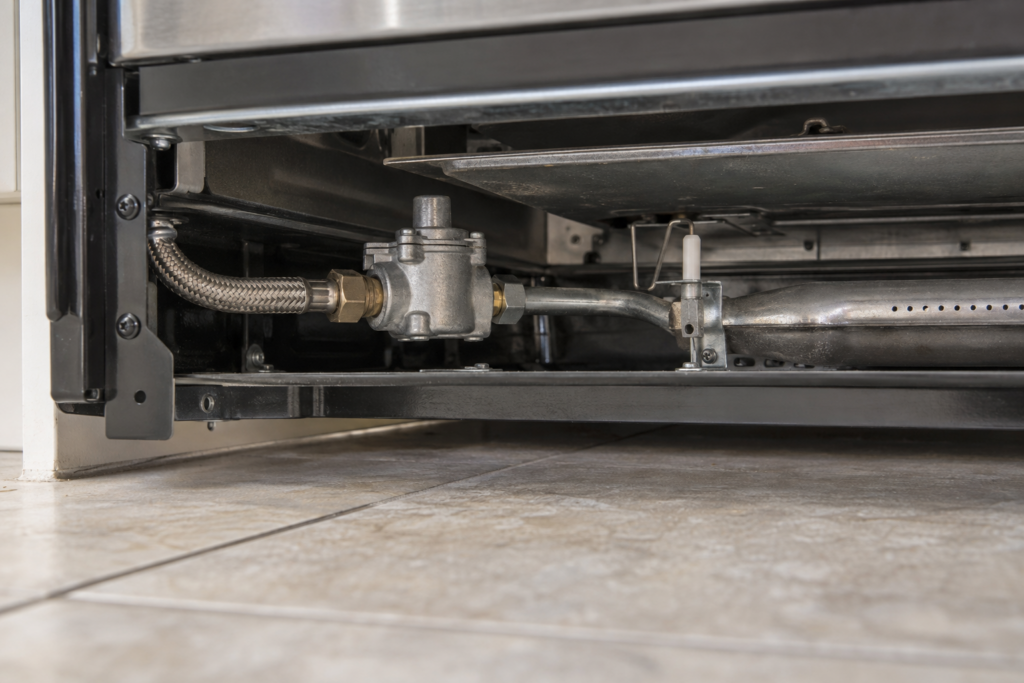
It means the oven's gas safety valve has failed, and the code page calls it a critical component failure. The valve is the part that opens when the igniter heats up and lets gas reach the oven burner; if it is seized, or its coil has opened, or it simply never receives the signal, the igniter glows but no gas flows. The Château gas range lists this as F5, which is different from the F1 oven igniter code on the same range, and different again from the dual fuel line.
The symptoms are distinctive once you know them. The igniter reaches full temperature and glows bright orange, but the oven burner never lights because gas cannot pass. There is no gas smell during the attempt, which separates a closed valve from an igniter failure, where a brief odor may be detected. And the cooktop works normally while the oven does not, because the cooktop burners use separate valves.
The code page lists three causes, and the repair-or-replace answer differs for each:
- A seized valve: the bimetal mechanism has seized from age, corrosion or heat damage and cannot open, which means a replacement valve.
- A failed valve coil: the coil that heats the bimetal element has opened, so the valve never receives the signal to open, which also ends in a replacement.
- A control board not sending the signal: the valve itself may be functional, so the repair is on the board and the valve stays.
Can You Keep Using the Oven if the Valve Sometimes Works?
No: if the valve intermittently works and the oven lights sometimes, stop using it and schedule the repair, because an intermittently failing valve is unpredictable. A valve that opens on a good day and sticks on a bad one is a valve you cannot plan around, and the page names it as a reason to stop rather than as an encouraging sign.
- Do not attempt multiple ignition cycles when the valve is not releasing gas; it only wears the igniter.
- Do not treat a successful light as a repair. A power cycle may release a seized valve temporarily without fixing it.
- Use the cooktop in the meantime, since it runs on separate valves.
How Do You Tell a Failed Valve From a Failed Igniter?
Look at the igniter during a start attempt: if it glows bright orange, the igniter is fine and the valve is the problem. A properly glowing igniter eliminates igniter failure as the cause, and that is the single most useful observation you can bring to a repair visit. The cooktop test gives a second clue, because working cooktop burners confirm the gas supply to the range is fine.
- Start the oven and watch the igniter through the bottom vent for a bright orange glow.
- Light each cooktop burner to confirm the supply reaches the range.
- Switch the power off for five minutes, then restore it; a valve that opens afterward is still failing intermittently.
- Stop there. Everything beyond observation is a certified gas technician's job.
What the Replacement Includes
It is more than a swap, and that is part of why it belongs to a certified gas technician. Before any part is changed, the technician must verify the valve coil resistance, the igniter amperage and the control board output, which is how the third cause is ruled in or out. After the valve is replaced, a gas leak test and a combustion analysis are required before the oven is returned to use.
Our La Cornue range repair page lists gas valve and manifold pressure verification for Château gas models, and a gas valve or thermocouple fault there starts from $225, with the final price confirmed after on-site diagnosis and a written estimate before any work begins. The page also reminds you that same-day visits are available for gas safety issues, so say so when you book.
Two pieces of preparation make the visit more useful. First, note exactly what you saw at the igniter and whether the oven ever lit, even briefly. Second, ask for the estimate to name which of the three causes was confirmed, since that is what decides whether the repair is a valve, a coil or a board:
- If the valve is confirmed, the work is a certified valve replacement followed by leak and combustion testing.
- If the board is implicated, the estimate should say so and leave the valve alone.
When Replacing the Château Becomes the Question
Only when F5 is one among several signs, or when the valve cannot be sourced in reasonable time. Older Château models use pilot-ignition systems and mechanical thermostats, which are fundamentally different from the electronic controls of the CornuFé, so the age and configuration of your range affect which parts apply. Our parts and lead times guide explains what a special-order part does to the schedule, and the parent decision guide is La Cornue range repair or replace.
For the safety side of oven valves and igniters, La Cornue gas range safety covers F1, F3 and F5 together. If you are not sure the valve is the cause, appliance diagnostics is the first step, and you can schedule a visit directly. Bring the observations from the igniter and cooktop tests, since they are the fastest way to confirm that the answer is a valve and not a range.