 Daniel Thornton
Key Takeaways
- E1 (heating element fault) on the vault oven is a repair situation in nearly every case, starting from $195.
- E1 means something different on every platform this site covers — on the vault oven specifically, it is always the heating element.
- Uneven heat points to a partially failed element; no response from the control panel at all points to the board instead.
- The element is accessible without disturbing the vault's structure, which is why the repair costs far less than owners often assume.
- Only a cluster of unrelated major faults, not a single element failure, would be a reason to consider the whole range.
The Bottom Line
A failed heating element on a La Cornue vault oven (E1) is a routine, contained repair starting from $195 — closer in scope to replacing a light bulb than to any decision about the range as a whole.
Code E1 on the vault oven's fault list — heating element fault — puts an owner in front of a decision that is far smaller than it feels: the element itself, not the vaulted oven as a whole, and certainly not the range it sits within. The heating element is the part responsible for the vault's signature even, radiant heat, and when it fails the oven either heats unevenly or stops heating altogether. This guide is about that one part on its own — repair it or replace it — kept separate from any wider decision about the range as a whole.
| Code | Fault | Repair path | Starting price |
|---|---|---|---|
| E1 | Heating element fault | Element replacement | from $195 |
| E0 | Control board init error | Board-level diagnosis | from $395 |
| E4 | Ventilation system fault | Vent path inspection | from $245 |
| E6 | Moisture sensor failure | Sensor replacement | from $185 |
| F8 | Steam generator fault | Descale or element service | from $195 |
La Cornue Oven Heating Element Repair or Replace: Which Is It?
Repair, in nearly every case. The element itself is a contained, accessible part, and at from $195 it sits at the low end of the vault oven's own fault list — well below what a control board diagnosis would run, and nowhere close to what removing and replacing a vaulted range would cost. There is essentially no scenario where an isolated heating element failure justifies looking beyond the element itself.
What E1 Means on the Vault Oven Specifically
E1 means the heating element that produces the vault's radiant heat has failed or is failing, either through a broken element or a connection issue at the terminals feeding it. This is a distinct component and a distinct code from the E1 that appears on the gas-range and dual-fuel-range platforms this site also documents — on those, E1 means a gas pressure fault or a gas valve relay failure, entirely different systems. On the vault oven specifically, E1 is always about the heating element.
That distinction is worth remembering if you own more than one La Cornue appliance or are researching this code online, since a search for "La Cornue E1" without specifying which platform will surface information about a completely different fault on a different system. Always confirm which appliance and which platform the code was posted on before assuming what it means, since the same two characters carry three entirely different meanings across the ranges this site documents.
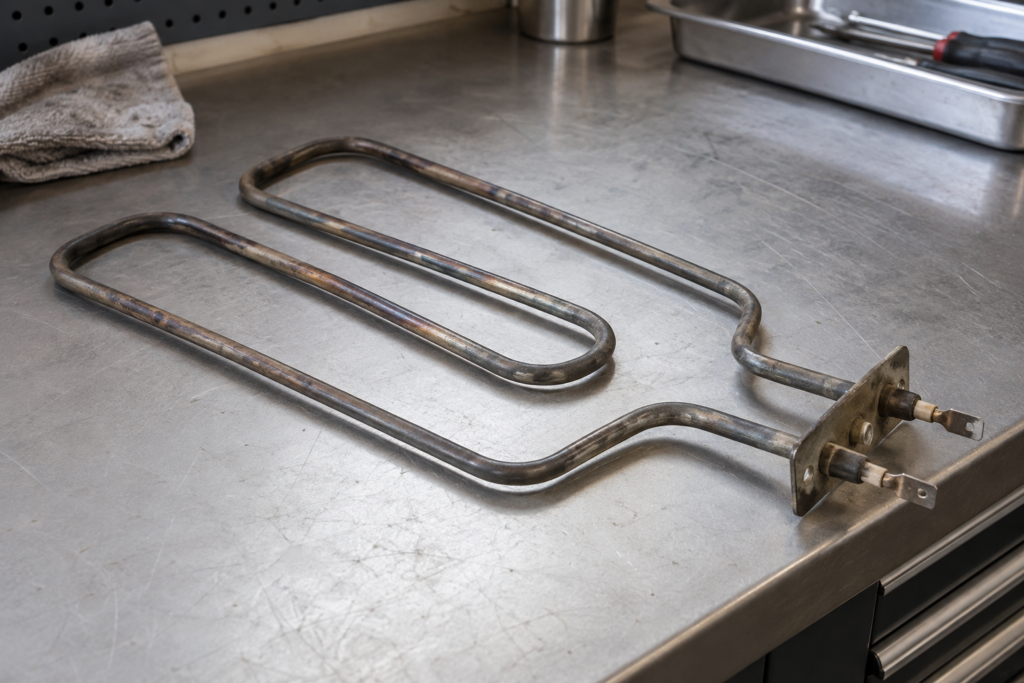
The element sits along the base or rear of the vault chamber, out of sight during normal use, wired to the control system through a set of terminals that can themselves loosen or corrode over time independent of the element's own condition. That is why a technician tests both separately rather than assuming a failed element from the code alone — a loose terminal is a five-minute fix, while a genuinely failed element requires the part itself, and confusing the two would mean ordering a replacement component that was never actually needed in the first place.
How Do You Know It's the Element and Not the Control Board?
- Uneven heat across the vault, with one area noticeably cooler than the rest, points to a partially failed element rather than a control issue.
- No heat at all despite the control panel responding normally points to a fully failed element or its connection.
- The oven not responding to any input at all, including the display, points toward the control board (E0) rather than the element.
- Heat cycling on and off rapidly without reaching temperature suggests a connection issue at the element terminals rather than the element itself.
- A burning smell on first use after a long idle period is often just dust burning off and clears within a few minutes, not a sign of element failure.
- Visible discoloration or damage to the element, when accessible, is a direct confirmation rather than an inference from symptoms alone.
Why This Repair Costs Less Than It Sounds
Because the element is accessible without disturbing the vault's structure or any sealed system — it is a wired, replaceable component, not something embedded permanently into the oven's construction. The vault's distinctive shape and the hand-applied finish that make La Cornue ranges what they are apply to the exterior and the cooking chamber itself, not to the heating element, which is standard-format wiring and hardware behind an access point. Understanding that distinction is what keeps a repair estimate grounded in reality rather than assuming every part on a hand-built range carries the same premium as the visible finish.
- Accessing the element, typically through a rear or lower service panel on the vault assembly.
- Testing the element and its connections separately to confirm exactly which has failed.
- Replacing the failed component — the element itself, or just the connection, depending on the test result.
- Running a full heat cycle to confirm even temperature across the vault before closing the job out.
When Would Replacing the Whole Range Make Sense Instead?
Only if the element failure is one of several unrelated issues appearing across the range at the same time, or if the range has already needed extensive work — a control board, a gas valve, significant cosmetic restoration — that collectively approaches what a comparable new range would cost. An isolated E1 on a vault oven, on a range that is otherwise sound, is never on its own a reason to consider replacement; it is a routine, contained repair. For the broader repair-or-replace picture across the whole oven rather than this one part, La Cornue oven repair or replace covers that wider comparison directly.
This is worth keeping in perspective specifically because a La Cornue range represents a significant investment, and it is easy to let one fault code trigger disproportionate worry about the whole appliance. The vault's heating element failing is closer, in scope, to a light bulb burning out than to a structural problem with the range.
- An isolated E1 on an otherwise sound range is a routine repair, full stop.
- E1 alongside a control board or gas system fault in the same visit is worth a broader conversation about the range's overall condition.
- Cosmetic wear on the exterior is a separate consideration entirely and does not factor into whether the element itself is worth fixing.
Booking the Repair
This is routine work through La Cornue oven repair, priced from $195 for the element itself per this site's own service pricing, or start with an appliance diagnostics visit if the cause is not yet clear. For the oven's other systems, including the steam generator that operates independently of this element, La Cornue oven care covers the fuller maintenance picture, and La Cornue vault oven door issues covers a separate, unrelated fault on the same appliance. When you are ready, schedule a visit or contact us with the symptom pattern you have observed.