 Daniel Thornton
Key Takeaways
- F4 on convection ovens and E2 on dual fuel ranges both mean the convection fan motor is not working properly.
- Conventional bake and broil still work, so only convection is affected.
- Grinding, squealing or burning smells from the back of the oven mean stop using convection modes.
- The motor is a routine repair on a La Cornue; replacement of the whole oven is for cases where several parts are failing.
- The F4 page lists a typical repair from $320, confirmed on site after diagnosis.
The Bottom Line
Repair the motor and keep the oven: a silent convection fan rarely justifies replacement. Use conventional bake and broil meanwhile, get an itemized estimate, and think again only if the fan is one of several failing parts.
An oven that cooks unevenly in convection mode and fine in conventional bake has told you something specific: the fan that moves the air has stopped. On this site that is code F4 on convection ovens and E2 on dual fuel ranges, and both pages say the same helpful thing, that the rest of the oven still works. The La Cornue convection fan motor repair or replace choice looks bigger than it is, because the motor is one part and the oven around it is almost always worth keeping.
| Situation | Code | Repair the motor? | Replace the oven or range? |
|---|---|---|---|
| Convection fan silent, conventional modes fine | F4 or E2 | Yes | No |
| Fan grinding or squealing | F4 or E2 | Yes, soon, before it seizes | No |
| Motor repair plus an aging control board | F4 and a board code | Compare both estimates | Possibly, if several parts are failing |
| Foil or debris jamming the blade | E2 | Clear it; no part may be needed | No |
What Do F4 and E2 Mean on a La Cornue Oven?
Both mean the convection fan is not turning properly. F4 is the convection oven code, "convection fan motor failure," with a typical repair from $320. E2 is the dual fuel range code, "convection fan motor fault," rated low severity. Both pages say the oven can be used in conventional bake and broil, since only the convection function is affected.
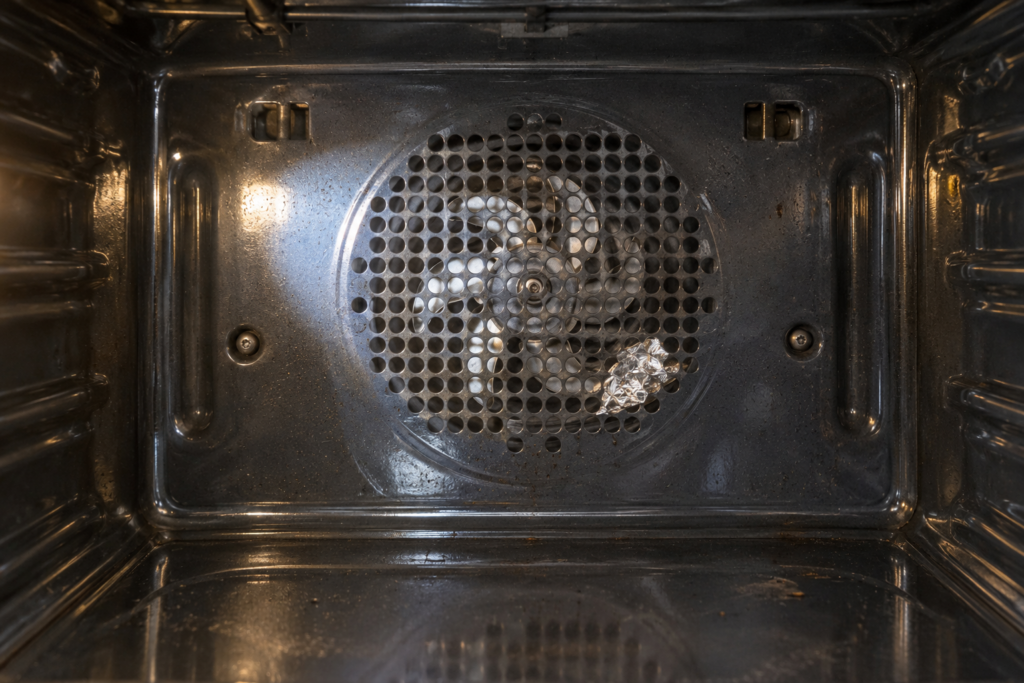
The symptoms match: uneven cooking and browning, no fan noise when convection is selected, and sometimes grinding, humming or clicking from the back of the oven before the code appears. If you hear metal on metal, stop using convection modes; if you smell burning from the rear, disconnect the power.
Can You Keep Using the Oven in the Meantime?
Yes, in conventional bake and broil, and with limits. Both pages say that only the convection function is affected, so the oven is not unusable. The limits come from how the fault behaves: the F4 page says a power cycle may clear the error temporarily but it returns when convection is selected if the motor is faulty, and the E2 page says the fan may work intermittently if the cause is a bearing, but the problem will progressively worsen.
- Use conventional modes and avoid convection until the motor is repaired.
- Do not keep re-selecting convection hoping it will start; a struggling motor wears further.
- Stop at once if you hear grinding, a metal-on-metal sound, or a loose blade rattling, which the F4 page says to treat as a reason to stop using any oven function.
- Disconnect power if there is a burning smell from the rear of the oven.
Why the Fan Fails
Heat, mostly. The pages list a burned-out motor or worn bearings from years of heat exposure, a seized bearing from grease breakdown, broken motor wiring, and, on E2, an obstructed blade. Food debris or foil that has fallen against the blade is the one cause the owner can address, and it is worth a look with the oven cool before booking.
- Worn or seized bearings. The motor turns slowly or not at all, and the E2 page warns the fan may work intermittently and then worsen.
- Burned-out windings. The motor does not respond at all.
- Broken wiring. Often near connection points; intermittent operation is a clue.
- A jammed blade. Foil or debris physically stops it; clear it only with the oven cool and off.
It helps to be clear about what the failed part is. The convection fan is a small motor, on many ovens behind the rear wall of the cavity, that moves hot air around. The heating, the door, the enamel cavity and the gas or electric supply are not touched by the fault, which is why the oven keeps working in conventional modes.
Is It Worth Repairing the Fan Instead of Replacing the Oven?
Yes. A convection fan motor is a part that wears out on any oven, and a La Cornue is built to be serviced: the repair services page lists convection motor replacement among the routine oven repairs, and the parts page lists convection fan motors among the parts it sources. A range of this kind is a large purchase with brass fittings and a vitreous enamel cavity, so the sensible default is to repair.
The question changes only when the motor is not the only problem. If the oven also has a failing control board, a door lock fault and a temperature sensor code, you are looking at a list rather than a repair, and the guides to repairing or replacing a La Cornue oven and a La Cornue range are the parents for that whole-appliance call.
What Does the Repair Visit Look Like?
The code pages put the technician's time at two to three hours for a convection fan motor, and the work is usually a motor replacement. On many models the motor sits behind the rear wall of the oven cavity, so a technician typically tests the motor and its wiring first, replaces the motor if it has failed, and checks that the blade turns freely before the oven is put back to work.
The site's diagnostic visit covers component-level testing with calibrated instruments, which is what separates a seized bearing from a wiring break. The estimate then comes in writing, and the diagnostic fee is credited toward the repair if you proceed.
Questions to Ask Before Approving the Repair
Ask three things: what the part and the labor cost separately, how long the part will take to arrive and whether anything else was found. The site says estimates are written and itemised, and that legacy parts can have longer lead times.
- Is the motor the whole repair? A failed motor can come with a worn blade or damaged wiring.
- How long until the part arrives? Convection motors for older models may need to be sourced.
- Is the fan the only fault found? The visit includes a convection fan inspection and bearing assessment on a maintenance visit, which can catch the next one early.
- What will conventional baking do meanwhile? The page says it is fine to use, while convection waits.
Avoiding the Next Failure
Keep the oven clean and book the maintenance visit. The preventive maintenance page lists a convection fan motor inspection and bearing assessment as part of the oven visit, which is the best chance to catch a tired bearing before it seizes. Our La Cornue oven repair service replaces convection motors, and the oven care guide covers routine care.
The code pages convection oven F4 and dual fuel range E2 have the full symptom lists. Schedule a visit or contact us with the model and the code, and the estimate will be in writing before any work.