 Daniel Thornton
Key Takeaways
- A Château is built to order and fitted to its opening, so replacement carries cabinetry, countertop, gas and ventilation costs that never appear on an appliance price.
- Mechanical thermostats and pilot ignition age better than electronics: there is no discontinued board to end the range.
- On a gas range F1 is an oven igniter failure, while on the dual-fuel platform F1 is an open temperature sensor. Reading the wrong list is how owners buy the wrong part.
- Structural damage behind the enamel, or a part with no equivalent at all, are the real cases for replacement. A single expensive assembly is not.
- Get the repair quoted in writing and add the trades to the replacement side before comparing anything.
The Bottom Line
Compare the written repair estimate against the full cost of replacement, including the cabinetry and supply work a bespoke range demands. Unless the body is damaged or the part truly does not exist, repair is usually the shorter road.
The Château is the line La Cornue has built to order since 1908, and the number in the name is the width in centimeters: 75, 90, 120, 150, 165. Owners weighing a Le Château 75 repair against a replacement usually start by comparing the repair quote to the price of a new range, which is the one comparison that does not apply here. A Château was made for its opening, its gas supply, and its ventilation. Taking it out is not a swap, it is a renovation.
| Question | Points toward repair | Points toward replacement |
|---|---|---|
| What failed | Igniter, thermostat, valve, burner, hinge | Firebox or enameled body damage |
| Part availability | Current or special-order part exists | Nothing equivalent can be sourced |
| Cabinetry | Opening was cut to this range | Kitchen is being rebuilt anyway |
| Fuel and supply | Gas line and electrics unchanged | Converting fuel type entirely |
| Control generation | Mechanical thermostat, pilot ignition | Owner wants modern electronic control |
| Finish | Enamel and brass restorable | Structural corrosion behind the enamel |
A Château Is Not Interchangeable With Anything
Standard American ranges come in standard widths, which is why replacing one is a Saturday. A Château does not. The opening in the cabinetry was cut to the range, the countertop was scribed to it, and the gas and electrical runs were brought to where that particular configuration needed them. A 75 is not a 90 with the sides trimmed.
That means the replacement side of this decision carries costs that never appear on an appliance price tag: cabinetry, countertop work, possibly a gas line run, possibly ventilation changes. Any comparison that skips those is not a comparison at all. Our guide to range weight and installation covers what moving one of these actually involves.
Which Generation of Controls You Have Changes Everything
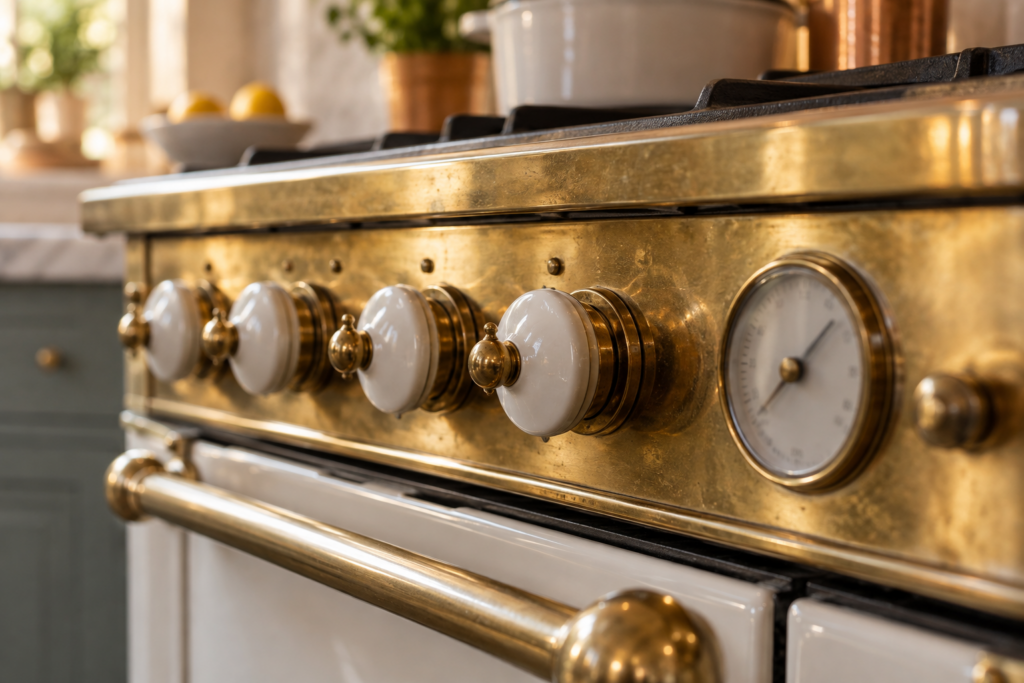
Older Château ranges use pilot ignition and mechanical thermostats. Newer configurations use electronic ignition and a control board. They fail differently, they are diagnosed differently, and they age very differently.
A mechanical system is, in the long view, the easier one to keep alive. There is no board to become unavailable, and a thermostat that has drifted is a serviceable component rather than a discontinued assembly. An owner of a mechanical Château is rarely forced into replacement by electronics, which is the single most common reason a modern premium range gets retired.
Electronic configurations bring their own codes. F1 on a gas range is an oven igniter failure, and F5 is a gas safety valve failure. Note that F1 here is the igniter, not the temperature sensor. On the dual-fuel CornuFé platform the same F1 means an open oven temperature sensor, and reading one platform's list against the other appliance is how owners end up ordering the wrong part.
Why the Width in the Name Matters to the Decision
The smaller Château widths sit in kitchens where the range is one element among several. The larger ones are usually the reason the kitchen was laid out the way it was, with ventilation, gas capacity, and traffic all planned around them. The same fault therefore carries a different weight depending on which range it happened to.
On a 75 or a 90, a replacement at least remains a contained project: the opening is closer to a conventional size, and the surrounding joinery may absorb a change. On a 150 or a 165, the range is effectively architecture. Removing it means an opening that fits almost nothing else, a hood sized for that footprint, and a supply arrangement made for those burners. Owners of the larger widths should treat replacement as a last resort and put the effort into sourcing the part instead.
What Genuinely Justifies Replacement
Three situations actually make the case, and none of them is a parts bill.
- Damage to the body or firebox. Enamel chips and brass tarnish are cosmetic. Corrosion or distortion in the structure behind them is not, and it is not economically repairable.
- A part that genuinely does not exist. Not a part with a long lead time, which is ordinary on this marque, but one with no current or substitute equivalent. Our guide to parts and lead times explains the difference.
- A kitchen already coming apart. If cabinetry and countertops are being replaced anyway, the largest hidden cost of replacement disappears, and the decision changes shape.
What does not justify it: a single expensive assembly, an ignition fault, a drifting thermostat, a worn door gasket, or the age of the range on its own. These are ranges built to be serviced, and a fifty-year-old Château in a French kitchen is not a curiosity.
How to Run the Comparison Honestly
- Get the repair quoted in writing before comparing anything. La Cornue range repair starts from $245, with the final price confirmed after the on-site diagnosis.
- Add the trades to the replacement side. Cabinetry, countertop, gas, electrical, ventilation, and removal of a very heavy appliance.
- Ask whether the fault recurs. One failed component on a well-kept range is an event. A third board in four years is a pattern.
- Check the finish separately from the mechanism. Restoring enamel and brass is a different trade from repairing a burner, and one does not require the other.
- Decide once. Repeated partial repairs while postponing the decision is the most expensive path of all.
Getting a Straight Answer
The useful first step is a diagnosis that says what failed and whether the part can be had, because that single answer settles most of this decision. A diagnostic visit starts from $165 and that fee is credited toward the repair if you go ahead with it.
Our La Cornue range repair service covers both the legacy pilot systems and the modern electronic configurations, and the same rule applies to every quote: the final price is confirmed after the on-site diagnosis, with a written estimate before any work begins. Book a visit or describe what the range is doing and we will tell you honestly which side of this the answer falls on.