 Daniel Thornton
Key Takeaways
- F5 (control board failure) is treated more seriously than a single-component fault because board behavior can be unpredictable rather than consistently wrong.
- The most serious signs are uncommanded burner ignition and an oven or burner failing to shut off when told to.
- Never attempt to reset a failing board yourself through repeated power cycling — it does not fix the fault and can mask it temporarily.
- A board repair is priced from $395 and involves testing every function, not just the one that produced a visible symptom.
- The same unpredictable-failure risk applies to control boards on other La Cornue platforms, though the specific code differs by range.
The Bottom Line
F5 on a CornuFé range means the control board is failing in a way that can be unpredictable rather than consistent — stop using the range if you see uncommanded ignition or a failure to shut off, and book service rather than reset it repeatedly.
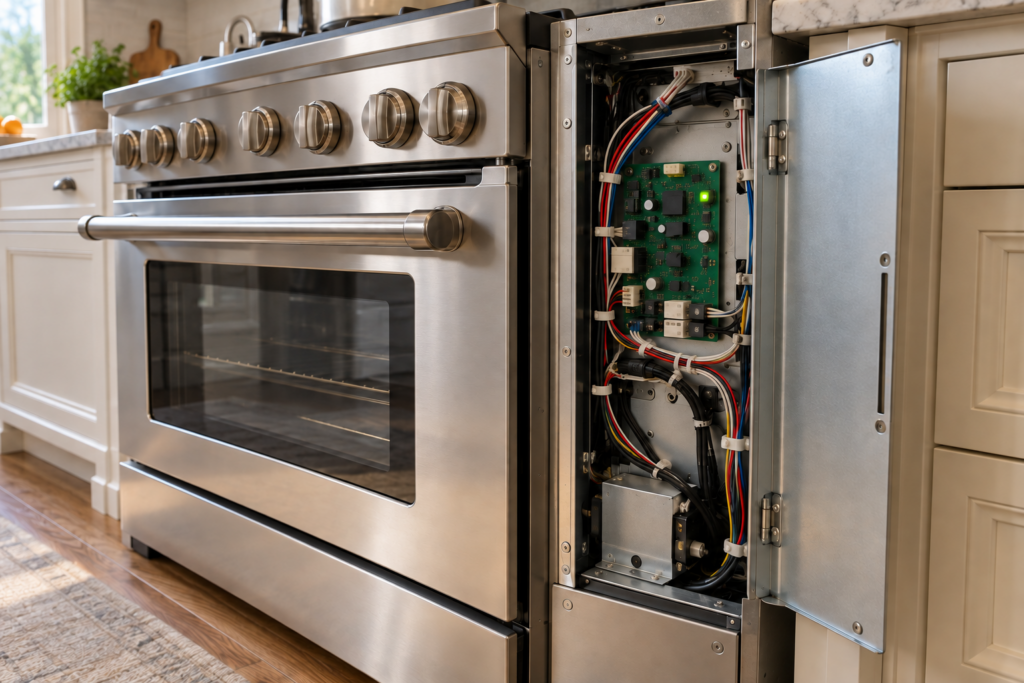
Code F5 on a CornuFé dual-fuel range — control board failure — is one of the more serious entries on this site's fault lists, and it is flagged for a reason that goes beyond simple inconvenience: a failing control board can produce erratic heating behavior that is not obvious from the outside until it has already affected a dish, or worse, left a burner or the oven running longer or hotter than intended. This guide covers La Cornue CornuFé control board failure safety specifically — what F5 actually risks, how to recognize it before it becomes dangerous, and why continuing to use the range through it is not a reasonable gamble.
| Sign | Risk level | Likely cause | What to do |
|---|---|---|---|
| Oven temperature drifting from the set point | Moderate | Board losing accurate sensor communication | Monitor closely, book service soon |
| Burner igniting without being commanded | High | Board sending incorrect signals | Stop using immediately |
| Display frozen or unresponsive | Moderate | Board communication failure | Power cycle, then book service |
| Oven not shutting off when commanded | High | Board failing to execute commands | Cut power at the breaker, book service |
What Does F5 Actually Mean?
The control board is the component that translates every input on the range — a burner selection, a temperature setting, a timer — into an actual electrical or gas command to the corresponding part. F5 means that translation process has failed or is failing, which is a different and more serious category of fault than a single sensor or igniter failing, because a compromised board can affect commands it has not yet visibly failed to execute correctly.
Why This Is Treated More Seriously Than Other Faults
Because a board failure is unpredictable in a way that a single-component failure is not. A failed sensor produces a consistent, wrong reading. A failed igniter simply does not ignite. A failing board, by contrast, can behave normally for most commands and incorrectly for others, which means the range can appear to work while intermittently doing something it was not told to do — continuing to heat past a set point, or failing to fully shut off a burner. That unpredictability is exactly why this fault sits in the safety-and-risks category rather than the ordinary common-problems list alongside a burner that simply will not light.
The Specific Risks Worth Understanding
- Uncommanded ignition is the most serious scenario — a burner igniting without being told to, which is a genuine fire risk if anything is near the cooktop at the time.
- Failure to shut off means an oven or burner continuing to run past when it should have stopped, risking overheating of the appliance or its surroundings.
- Erratic temperature control in the oven risks both food safety, for dishes requiring precise temperature, and undetected overheating over a longer cook.
- A frozen or unresponsive display is the least urgent sign on its own, but it means you can no longer trust what the range is telling you about its own state.
- Any combination of the above happening together is a stronger signal of a genuine board fault than any one sign in isolation.
None of these signs need to be dramatic to matter. A board that intermittently misreads the oven temperature by a small margin is still the same underlying fault as one producing more obviously erratic behavior — the difference is only in how visible the symptom happens to be on a given day, not in how seriously it should be taken.
What to Do If You Notice Any of These Signs
- Stop using the range immediately if a burner ignites without being commanded or the oven fails to shut off when told to.
- Cut power at the breaker rather than relying on the range's own controls if you cannot confirm it is fully off.
- Do not attempt to reset the board yourself by power cycling repeatedly — this does not fix an underlying board fault and can mask it temporarily.
- Book service immediately rather than monitoring the range through additional uses.
- Keep a note of exactly what happened and when, since the specific pattern helps a technician test the right functions first.
How Is This Diagnosed and Fixed?
A technician tests the board's response to each command type systematically, rather than relying on which symptom happened to be visible, since a board that fails intermittently on one function may also be failing quietly on others that have not yet produced an obvious symptom. Range repair for a board failure is priced from $395 on this site's own service pricing, reflecting the more involved diagnostic and replacement work a board-level fault requires compared with a single sensor or valve.
Once replaced, the technician confirms every function — each burner, the oven, the display, and any safety interlocks — responds correctly before considering the repair complete, precisely because the risk with this fault is behavior that does not show up on the first test alone. An appliance diagnostics visit is the right first step if the symptom is subtle enough that you are not certain it warrants the full board-level conversation yet.
Does This Apply to Other La Cornue Platforms Too?
The same general risk profile — unpredictable rather than consistent failure — applies to control board faults on any platform this site covers, though the specific code and the exact commands at risk differ by range. For the gas-only platform's own safety profile, La Cornue gas range safety covers a different set of risks tied to ignition and gas pressure specifically, and CornuFé 110 repair cost covers pricing across the rest of this platform's fault list. If your CornuFé is showing F5 or any of the signs above, schedule a visit or contact us rather than continue using the range.
What to Tell the Technician Before They Arrive
A precise description of what happened matters more here than with most other faults on this site, because the technician needs to know which functions to test first among many possible ones.
- Exactly which burner or function behaved unexpectedly, and whether it has happened more than once.
- Whether the display was responsive at the time, or frozen along with the unexpected behavior.
- Any pattern to when it happens — a specific setting, a specific time of use, or no discernible pattern at all.
None of this information changes what needs to happen — the range still needs a technician's attention — but it does change how efficiently that visit goes, since a board with dozens of possible functions benefits enormously from a technician knowing where to start looking first rather than testing every function from scratch in an arbitrary order. For a range that has already had a board replaced once, mentioning that history is equally useful, since it helps rule out whether the same underlying cause is recurring.