 Daniel Thornton
Key Takeaways
- E1 (gas valve relay failure) is worth fixing in nearly every case — it starts from $225, well below the from $395 top tier on the same fault list.
- The relay switches power to the gas valve solenoid; when it fails, the igniter can glow normally while gas never reaches the burner.
- A relay failure and an igniter failure look similar from the outside but require different tests and different parts.
- The range's age does not change whether a standalone relay failure is worth fixing — it is a low-cost, non-sealed component either way.
- Only a cluster of several electrical faults happening together, not a single relay failure, would be a reason to reconsider.
The Bottom Line
A CornuFé gas valve relay failure (E1) is a routine, inexpensive repair starting from $225 — worth fixing on almost any range, regardless of age, and easy to mistake for a pricier igniter problem if it is not tested directly.
A CornuFé that throws code E1 — gas valve relay failure — leaves the oven side of a dual-fuel range unable to reliably control gas flow to the burner, and it is a fault worth evaluating on its own terms rather than folding into the wider "is my CornuFé worth keeping" conversation this site already covers elsewhere. This guide is specifically about the relay: what it costs, how it compares with the rest of the dual-fuel fault list, and whether it is worth fixing on a range that has otherwise been reliable.
| Code | Fault | Worth fixing? | Starting price |
|---|---|---|---|
| E1 | Gas valve relay failure | Yes — routine electrical component | from $225 |
| E2 | Convection fan motor fault | Yes — accessible part | from $245 |
| F1 | Oven temp sensor open | Yes — inexpensive sensor | from $195 |
| F5 | Control board failure | Usually — compare against range age | from $395 |
| E0 | Board communication error | Yes — often a connector, not the board | from $195 |
Is a La Cornue CornuFé Gas Valve Relay Worth Fixing?
Yes, in nearly every case. E1, the relay, is an electrical switching component that controls power to the gas valve solenoid — it is not the valve itself, and replacing it does not require any gas-line work beyond disconnecting and reconnecting the valve's electrical control. At from $225, it sits solidly in the routine-repair tier of this range's fault list, well below the from $395 that a control board failure would cost. That gap matters because the two are easy to confuse without a direct test: both can produce an oven that will not reliably ignite, and only one of them requires the more expensive board-level work.
The relay's low cost reflects how it is built and accessed, not any judgment about how important it is to the oven's operation — without it, the gas valve never receives the signal to open, and the oven simply does not heat. A part being inexpensive to replace does not mean it is unimportant; it means the component itself is small, standardized, and does not require opening any sealed system to service at all.
What the Relay Actually Does
It sits between the control board and the gas valve solenoid, switching power on and off as the oven's control logic calls for heat. When the relay fails, the control board can send a signal that never actually reaches the valve, which shows up as an oven that will not ignite reliably or cycles unpredictably even though the igniter itself tests fine. This is why E1 on a CornuFé oven can look, from the outside, like an igniter problem — the symptom is similar, but the actual failed component is upstream of the igniter entirely. Relays fail in one of two ways: they stop closing the circuit at all, which leaves the oven completely unable to ignite, or they close intermittently, which produces the more confusing pattern of an oven that lights normally sometimes and not others.
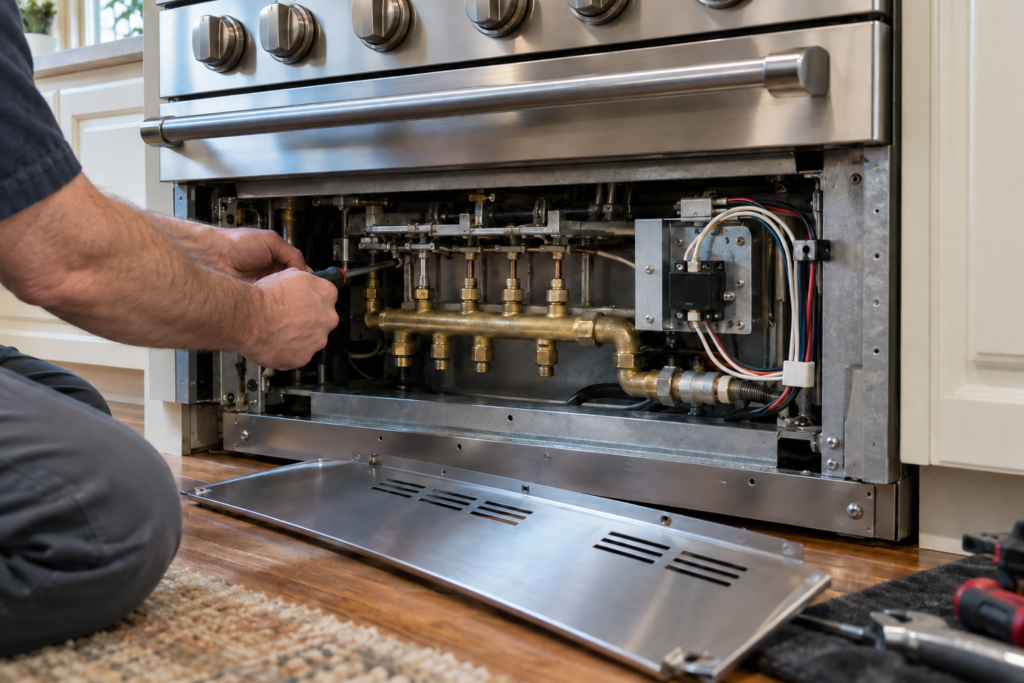
That intermittent pattern is worth describing carefully when booking service, since it is easy to mistake for a flaky igniter or a draft affecting the flame. A relay closing intermittently is an electrical fault, and no amount of adjusting airflow around the oven will make it more consistent.
How Is This Different From an Igniter Problem?
An igniter failure and a relay failure can look similar from the front of the oven — both result in an oven that will not reliably light — but they are different parts with different costs and different fixes.
- A failed igniter typically glows weakly or not at all when the oven calls for heat, and is a direct hardware failure of the glow-bar itself.
- A failed relay can leave the igniter glowing normally while gas never actually reaches the burner, because the valve was never told to open.
- A technician tests both separately rather than assuming which one failed from the symptom alone.
- Replacing the wrong part first — an igniter when the relay is the actual fault — wastes both money and a visit.
- An intermittent relay produces inconsistent lighting that can be mistaken for a draft or a weak igniter, rather than a clean on/off failure.
The Range's Age Rarely Changes the Answer
Not meaningfully for the relay specifically, since it is a low-cost, non-sealed electrical component regardless of how long the range has been in service. Where age matters is in whether the relay failure is an isolated event or one of several issues appearing close together — a CornuFé that has also needed board or ignition work recently is worth evaluating as a whole rather than repair-by-repair, but a single relay failure on an otherwise reliable range is a straightforward yes on its own.
- An isolated E1 on a range with no other recent faults is a routine repair regardless of the range's age.
- E1 alongside a recent board or ignition repair is worth discussing with a technician as part of the range's overall condition.
What a Relay Replacement Actually Involves
- Testing the relay directly rather than assuming it is the cause from the symptom alone.
- Confirming the igniter and gas valve solenoid both test normally before replacing the relay.
- Accessing the relay, typically through a rear or lower service panel rather than requiring the range to be pulled out.
- Testing full ignition cycles after the swap to confirm reliable operation, not just a single successful light.
- Checking the wiring harness near the relay for any wear or corrosion that could cause a repeat failure.
This is routine work through La Cornue range repair, and it does not require the more involved access that a control board or gas valve solenoid replacement would. An appliance diagnostics visit is the right starting point if you are not yet sure whether the fault is the relay, the igniter, or something else entirely. For the oven-specific safety concerns tied to unreliable ignition, La Cornue gas range safety covers what to watch for when an oven does not ignite consistently. When you are ready, schedule a visit or contact us with the symptom pattern you have observed.
When Would This Not Be Worth Fixing?
Only if the relay failure is one of three or more separate faults appearing on the same range within a short window, which would suggest a broader electrical issue rather than a single component reaching the end of its life. A standalone E1 code, even on an older CornuFé, does not meet that bar — it is a routine, inexpensive repair on a part that fails independently of the range's age or overall condition. For the cost of dual-fuel repairs more broadly, CornuFé 110 repair cost covers a wider range of components on the same platform.