 Daniel Thornton
Key Takeaways
- Nearly every rôtisserie problem starts as fat left where it landed: in the tray it wipes away, on the vault walls and at the forks it carbonizes.
- Empty and wash the drip tray while the oven is still warm; cold fat has to be scraped, and scraping is how enamel gets damaged.
- A bent spit side-loads the drive and cooks unevenly. Roll it on a flat counter to check, and store it supported rather than standing.
- Roasting loads ventilation harder than any other use, and the vault oven reports ventilation faults separately from temperature faults.
- A drive that will not turn a normal load should never be forced; that is the moment a cleaning job becomes a repair.
The Bottom Line
Wash the tray, spit and forks after every use while things are still warm, keep the spit straight, and run the drive empty every few weeks when the rôtisserie is idle. A stiff or jerky drive is a service call, not a cleaning problem.
The Flamberge is the rôtisserie option fitted into the vaulted oven, and it is the part of a La Cornue that owners either use constantly or forget entirely. Both habits cause problems, and they cause different ones. Used weekly and cleaned casually, it accumulates fat in places no other part of the range collects it. Left unused for a year and then pressed into service for a holiday, it comes out of storage stiff, dull, and occasionally seized. Neither outcome needs to happen, and almost nothing here requires a tool.
| Task | How often | Why it matters |
|---|---|---|
| Empty and wash the drip tray | Every use, while still warm | Standing fat is the main smoke and odor source |
| Wash the spit and forks | Every use | Baked residue at the forks jams the drive |
| Wipe the vault walls | After roasting, once cool | Spatter carbonizes and darkens the cavity |
| Check the spit for straightness | Monthly if used often | A bent spit loads the drive and wobbles the load |
| Check the drive engagement | Monthly if used often | Slipping drive is a small fix caught early |
| Run it briefly when idle | Every few weeks | Keeps an unused mechanism from stiffening |
| Confirm the hood runs with it | Every use | Roasting loads ventilation harder than baking |
Everything Here Comes Back to Fat
A rôtisserie works by holding meat above a tray while it turns, and that means fat leaves the food continuously for an hour or more. Where that fat lands decides how much work follows. In the tray, it wipes out. On the vault walls, it carbonizes into a film that takes far more effort. In the drive end of the spit, it bakes into a varnish that eventually stops the mechanism turning smoothly.
The single habit that prevents nearly all of it is emptying and washing the tray while the oven is still warm but safe to touch, rather than the next morning. Warm fat wipes away. Cold fat has to be scraped, and scraping is how enamel gets scratched. The same logic runs through our oven care guide for the cavity as a whole.
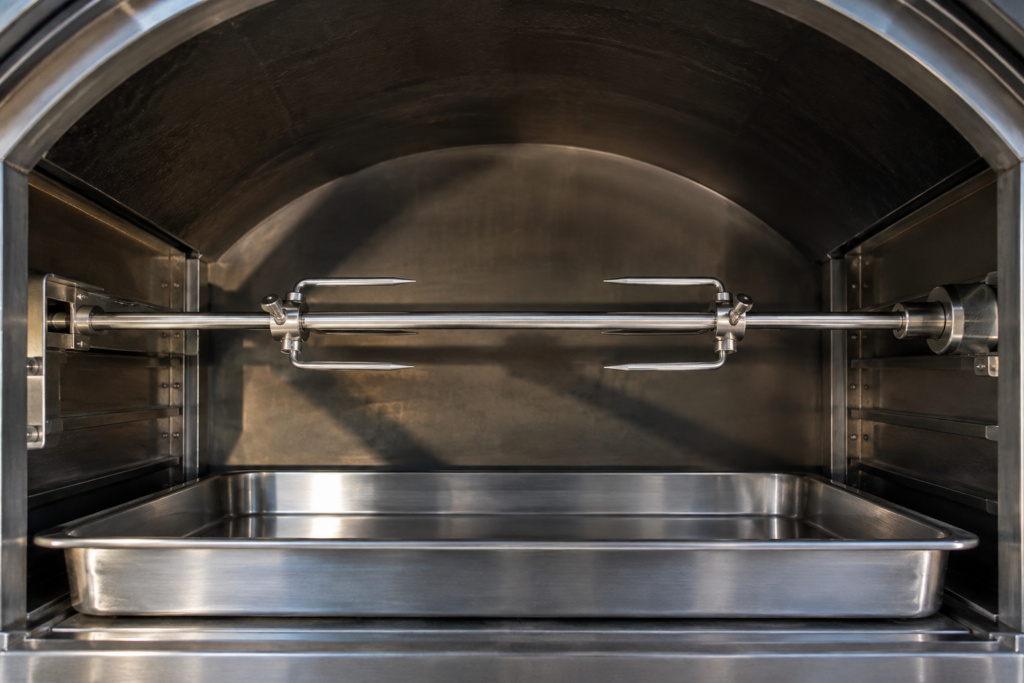
The Spit and the Forks Do the Mechanical Work
These two parts carry the entire load, and they are the parts most likely to be handled roughly. A spit is straight when it leaves the factory and stays straight unless it is leaned on, dropped, or used as a lever to shift a heavy roast. Once it is not straight, everything else suffers: the load wobbles, the drive takes a side load it was not designed for, and the cooking becomes uneven in a way people blame on the oven.
- Roll the spit on a flat counter to check it. A straight one rolls evenly; a bent one knocks.
- Tighten the forks onto the meat, not onto each other. Overtightening against the load distorts the tines.
- Balance the load before you start. A roast tied off center makes the drive work hardest at one point of every rotation.
- Wash the fork ends thoroughly. Residue baked at the clamp is what eventually resists engagement.
- Store the spit horizontally and supported, not standing in a corner where it can take a set.
Roasting Puts the Most Load on the Ventilation
An hour of open roasting produces far more vapor, smoke, and heat than an hour of baking, and it is the one use that reliably finds a marginal ventilation setup. If the kitchen fills with haze during a roast but not during anything else, the ventilation is the thing to investigate, not the rôtisserie.
The vault oven reports its own ventilation faults: E4 is a ventilation system fault on that appliance. Temperature faults show separately, with F1 as an open temperature sensor circuit. These are different problems with different remedies, and the code tells you which one you have before anyone opens anything.
There is also a simple habit worth adopting on the kitchen side: start the hood a few minutes before the roast goes in, and leave it running for a few minutes after the oven is switched off. A hood that begins working only once the room is already hazy spends the whole session catching up, and the difference in how the kitchen feels afterwards is obvious to everyone in it.
Before and After a Long Gap
Seasonal use is normal on a rôtisserie, and a mechanism that sits for months benefits from two small rituals. Before storage, clean everything thoroughly and dry it completely, because residue left on steel over a humid summer is what creates marks that will not polish out. Before the first use of the season, run the drive empty for a minute and watch it turn.
- Run the empty drive and listen for an even, unhurried rotation.
- Fit the spit without a load and confirm it seats and turns without catching.
- Check the tray sits flat and has not warped in storage.
- Run the oven empty at a moderate setting to burn off storage dust before food goes in.
- Do not force a stiff drive. That is the moment routine care turns into a Flamberge rôtisserie repair, and forcing it converts a small service into a large one.
When to Hand It Over
Three signs mean stop and call: a drive that will not turn a normal load, an uneven or jerky rotation that cleaning does not fix, and any burning smell that is not obviously the roast. All three point at the mechanism or the circuit that runs it, not at anything an owner services.
Our preventive maintenance service covers the rôtisserie together with the oven and the hood above it, and single-appliance maintenance visits start from $155. As always, the final price is confirmed after the on-site diagnosis, with a written estimate before any work begins. Book a visit or describe what the drive is doing and we will tell you whether it needs attention now or at the next service.